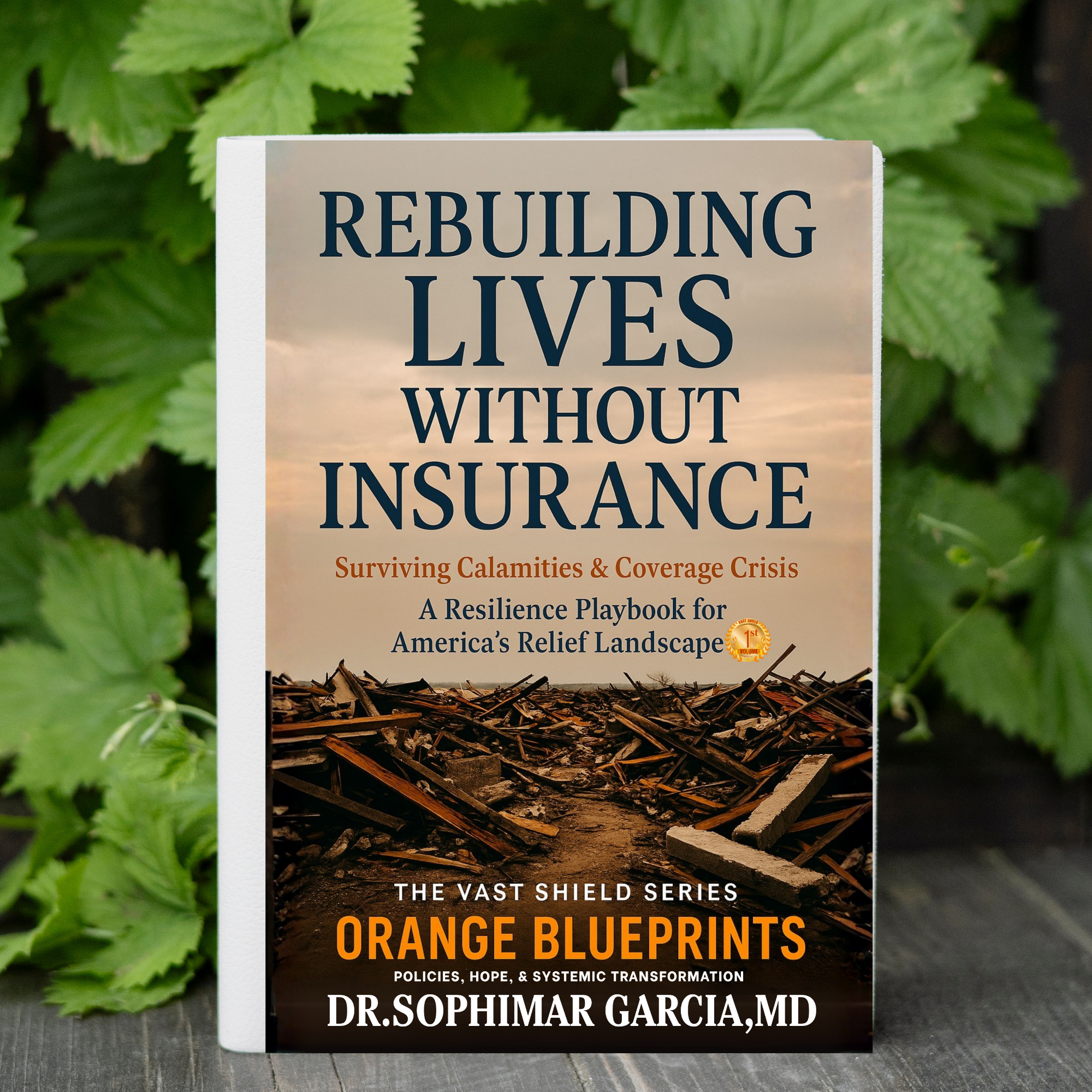
Rebuilding Lives Without Insurance
Surviving Calamities & Coverage Crisis: A Resilience Playbook for America's Relief Landscape
$299.00$49.99
Rebuilding Lives Without Insurance
Surviving Calamities & Coverage Crisis: A Resilience Playbook for America’s Relief Landscape
The Vast Shield Series: Orange Blueprints, Volume 1 – Policies, Hope, & Systemic Transformation
Discover the most essential guide ever written for America’s uninsured, underinsured, and disaster-affected families.
In an age of record-breaking storms, rising inflation, policy changes, and uncovered losses, Rebuilding Lives Without Insurance empowers you with clear, actionable solutions to recover faster—without relying on insurance alone.
Whether you’re a homeowner, renter, small business owner, farmer, or community leader, this digital blueprint reveals how to:
✔️Navigate FEMA, HUD, USDA, and SBA programs
✔️Access state cash assistance, agricultural recovery, and unemployment aid
✔️Use legal, nonprofit, and mitigation tools to fill insurance gaps
✔️Understand new policies from Project 2025, disaster deductible changes, and the FEMA Simplification Act (S.861)
✔️Prepare for leaner federal response systems with smarter local strategies
This is not just a book—it’s a survival tool. Authored by Dr. Sophimar Garcia, a disaster surgeon and global resilience advocate, this Volume 1 playbook is part of the Vast Shield Series: Orange Blueprints—designed to restore lives and fortify futures across America.
📘 Material
Digital Product – Instant PDF Download
🧰 What’s Inside This Must-Have Resilience Playbook
200+ infographics & flowcharts to simplify government aid
Federal & State relief comparison tables
Step-by-step aid application checklist
Policy summaries from FEMA, SBA, HUD, USDA
Real scenarios for homeowners, farmers, renters, and workers
Updated disaster contact list for all 50 states
Bonus: Legal aid access, appeal tips, and community rebuilding steps
🧭 Perfect For
Families hit by hurricanes, floods, fires, or earthquakes
The uninsured or denied insurance payouts
Self-employed or gig workers needing emergency income
Seniors, veterans, or disability households
First responders, caseworkers, and nonprofits guiding survivors
🏷️ Launch Price: $49.99
🚨 Original Value: $299
This is a limited-time pre-sale for early supporters. Secure your copy now before full release pricing applies.
🔒 Secure Your Digital Copy Now
✔️ Pay securely with Amazon Pay or Link
✔️ Instant PDF access upon official release
✔️ Lifetime updates & early access to Volume 2
🔍 Why This Book Matters More Than Ever
Every page of Rebuilding Lives Without Insurance responds to real crises — not theoretical ones. This book is not about blaming systems but about navigating, reforming, and ultimately transforming them.
📘 This Book Helps:
Disaster survivors without insurance navigate a confusing and overwhelming system
Families prepare for emergencies without relying on costly plans
Students and parents rebuild educational continuity post-disaster
Communities re-anchor after losing infrastructure and safety nets
Policymakers and advocates push for equitable, inclusive reform
🎯 Final Truth: Disasters Are Not the Great Equalizer—They Expose Inequality.
Without insurance, without privilege, without connections — people don’t just lose things. They lose time, health, safety, education, and dignity. This book fights to restore them all — practically, compassionately, and relentlessly.
Emergency Preparedness for Uninsured Americans | Disaster Recovery eBook | FEMA SBA HUD USDA Aid Guide | Survive Without Insurance | Digital Resilience Toolkit | Post-Disaster Playbook | Project 2025 Policy Explained | S.861 Simplification Act | Federal and State Aid Comparison Charts | Housing and Agricultural Disaster Relief | Self-Help Disaster Recovery Resource | Faith-Based & Nonprofit Disaster Support | Free Legal Aid Navigation | Disaster Mitigation & Rebuilding Blueprint | Economic Resilience After Catastrophes | Low-Income and Underinsured Emergency Recovery Guide | Disaster Cash Programs USA | Long-Term Rebuilding without Insurance
The Crisis We Can No Longer Ignore: Pain Points This Book Confronts Across Every Level of Society
1. Individuals and Survivors: Left Alone After the Storm
The Reality:
Millions of Americans find themselves devastated after a natural disaster — not just by the flood, fire, or hurricane itself — but by the aftermath. Without insurance, many victims face complete loss of homes, medical care, and livelihoods. Government help, when it arrives, is often too little, too late — or denied entirely due to eligibility gaps.
The Pain Points:
No homeowner’s or renter’s insurance → complete loss with no reimbursement
No disaster insurance → no help for rebuilding or repairs
No health insurance → no access to post-disaster trauma care or chronic disease management
Denial of FEMA help due to property title, ID, or missing documents
Complex and inaccessible application processes (online-only, English-only, bureaucratic)
Survivors burdened with PTSD, physical illness, and economic ruin
🧠 This book provides real-world navigation strategies for these individuals — empowering them with knowledge, step-by-step guides, and clarity when systems fail.
2. Families and Households: Multi-Generational Loss and Breakdowns
The Reality:
Disasters do not hit one person — they destabilize entire family units. Elderly parents, children, and caregivers are displaced together. With no insurance and no coordinated aid, families face homelessness, hunger, and trauma — often splitting up, depending on shelters, or entering unsafe situations.
The Pain Points:
No plan for child custody or guardianship during a disaster
Seniors or disabled family members abandoned or institutionalized
No continuity of care for those on life-saving medications
Domestic tensions escalate due to resource strain, job loss, or PTSD
No savings, no backup income → bankruptcy, homelessness, or relocation
💡 This book helps families build practical, low-cost emergency preparedness strategies — especially for the uninsured, undocumented, or underbanked.
3. Schools and Students: The Invisible Collapse of Education After Disasters
The Reality:
After a disaster, children’s lives are turned upside down — homes gone, schools closed, transportation cut off, and trauma unaddressed. Those without insurance or community advocates fall through every crack.
The Pain Points:
Students missing school for months due to displacement
No laptops, Wi-Fi, or remote learning options after relocation
Special education services disrupted indefinitely
No access to school counselors or trauma-informed care
Youth mental health crises go unacknowledged or untreated
🛠 This book proposes community-based educational continuity planning and resilience hubs, giving educators and families blueprints for safeguarding children's futures.
4. Communities: Broken Support Systems and Vanishing Neighbors
The Reality:
Entire neighborhoods are wiped out or emptied after a disaster. When homes are uninsured, recovery is slow — or never happens. Small towns lose churches, clinics, schools, grocery stores. The social fabric unravels, accelerating poverty, isolation, and migration.
The Pain Points:
Local governments are overwhelmed and underfunded
Closure of small businesses that served as community anchors
No coordinated volunteer or mutual aid systems
Chronic housing shortages post-disaster
Undocumented, migrant, and low-income communities suffer silently
🌱 This book presents scalable models for community rebuilding, disaster mutual aid, mobile clinics, and grassroots-led resilience zones.
5. Lawmakers & Public Officials: Policy Gaps That Worsen the Crisis
The Reality:
Federal and state disaster relief systems are fragmented, outdated, and biased toward those with insurance or clear documentation. The current frameworks leave out the most vulnerable — renters, non-English speakers, undocumented workers, and the working poor.
The Pain Points:
Inconsistent aid eligibility across states
Lack of standardization in disaster response
FEMA’s rigid definitions of “ownership” and “damage”
Overreliance on digital applications in underserved areas
Delayed or politicized disaster declarations and funding
⚖️ This book is a tool for reform — presenting solutions for equitable policy design, community-based disaster declarations, and modernized FEMA protocols that include everyone.